

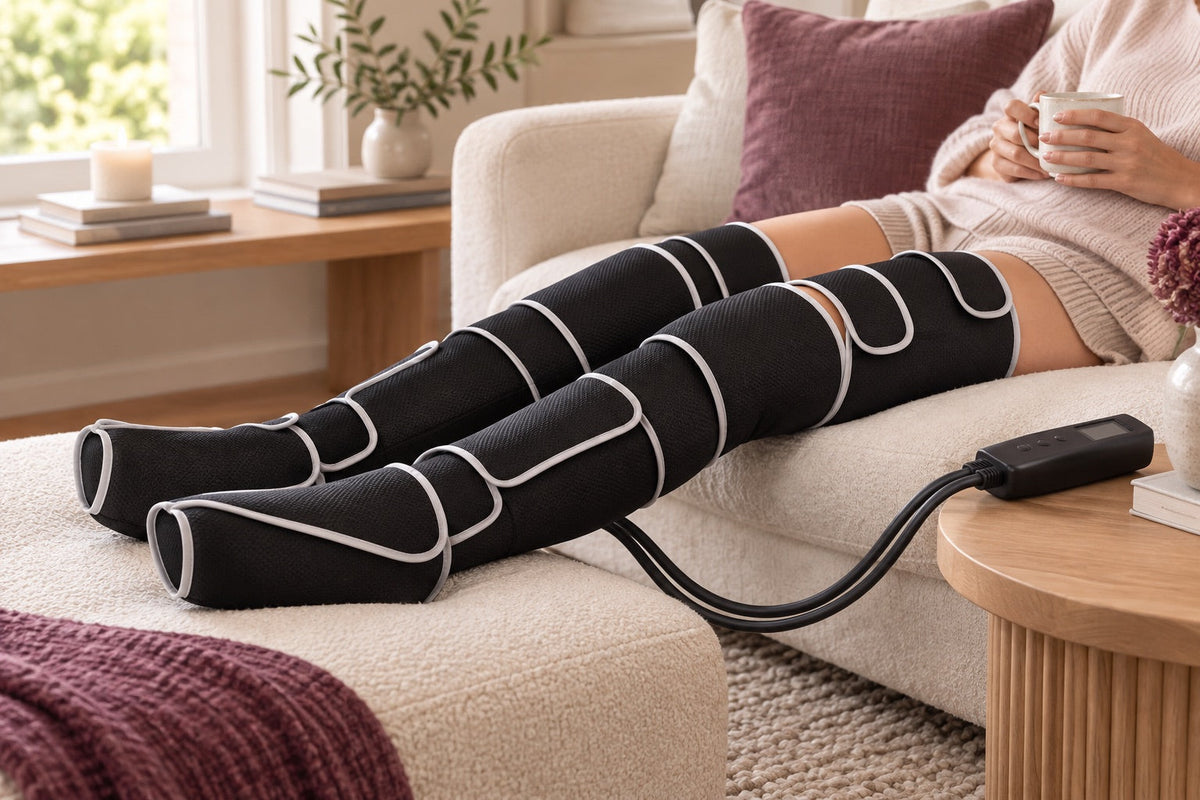
Air compression uses chambers that inflate and release according to the device’s programme. This creates a sensation distinct from vibration or mechanical kneading. The term describes a function, not a guaranteed medical outcome. When comparing models, look at the areas involved, the settings and the required positioning. This guide explains how to interpret those details without assuming that more programmes, stronger pressure or a larger device will necessarily suit your preferences better.
Compare areas and compression settings, check placement and keep a stop control accessible; higher pressure is not a goal in itself.
Distinguish compression from other functions
In a compression device, the air chambers change their volume in one cycle. Their arrangement contributes to the resulting sensation. This does not mean that all models inflate the same areas in the same order. A plug that simply mentions “air” or “compression” still leaves several questions open about the program and the intended placement.
The same product can associate this function with heat, vibration or another mechanism. Check which ones are actually present and whether they can be set separately. Do not assume that the main button activates all the options or that a program allows you to choose each zone. The manual remains the guide to understand the actual progress of the controls.
Check the zones and levels
The contact area determines what the device is designed to hold, such as feet, hands, or parts of a seat. A function with the same name does not become interchangeable between these formats. Look at the useful size, positioning marks, and advertised limits. An overly narrow housing or improperly placed strap cannot be corrected simply by choosing a lower level.
Intensity levels are model-specific. Level two of one device does not necessarily correspond to level two of another, and the number of levels alone does not measure the quality of the setting. Instead, compare the presence of useful options, their readability, and the ease of interruption. An understandable graduation counts more than a large number of poorly explained programs.
Check positioning before activation
Install the product according to the illustrations in the reference and check the position of the body before starting. The chambers must be in the intended places, without twisting the straps or moving the lining. Do not remove inner protection to save space if this configuration is not allowed. Textile elements can participate in the normal operation of the whole.
Keep the controls accessible and identify the stop and release procedure. This check is especially useful when the hand or foot is in a compartment. You need to know how to finish the use without waiting for the end of a cycle. If the initial placement seems restrictive, stop the preparation and look for the cause before activating the compression.
Try a cycle without seeking maximum pressure
Follow the recommended starting setting and take time to recognise the inflation and release phases. A programme can change during a session, so its first few seconds may not show the entire sequence. However, you do not need to endure an unpleasant sensation to let the device work. Use the prescribed stop control whenever you want to end the session, including before the scheduled finish.
Change only one parameter at a time to understand its effect. If multiple functions are active, identify which one changes the feel rather than increasing all the settings. The stronger compression is not automatically more pleasant, and the intensity felt is not a proof of benefit. Stay in the documented uses and in an experience that you can easily control.
Respect time and use limits
Consult the cycle duration, breaks and restrictions specific to the reference. An automatic stop does not mean that you have to reach this limit every time, nor that a new session can follow immediately. The instructions concern both the operation of the device and its conditions of use. They cannot be replaced by a habit taken on another product.
Read the warnings before the first test. If your medical condition, sensitivity or a medical device raises a question, ask for an appropriate opinion. A compression comfort device should not be considered, based solely on its mechanism, as a prescribed medical device. This article describes reading guidelines and does not assess an individual medical situation.
Distinguish a setting issue from a fault
Improper placement can change the feel, but unusual behavior should not always be attributed to improper setting. If an area does not relax as expected, if a noise changes markedly, or if the stop does not respond, follow the safety procedure in the user manual and stop using. Do not repeat cycles in an attempt to unblock the system.
To request support, note the reference, program, and step involved. Describe what is happening rather than trying to name an internal failure. Do not open the air chambers, pipes, or enclosure. A photo of the installation and an accurate description of the behavior can help guide the check without exposing unnecessary personal information.
Protect chambers and connections during care
Clean surfaces and protectors only according to the intended method. Do not pierce an inflatable part or compress it to accelerate its deflation. Parts that appear flexible may contain connections or membranes sensitive to folds. Also respect the storage positions to avoid keeping an area under a heavy object.
Keep the accessories and power supply identified with the model. Before the next use, check the assembly, the visible state and the drying of the washed parts. Understanding compression is finally to connect three pieces of information: where it acts, how it adjusts and how it stops. These marks allow you to choose and use the format more clearly, without excessive promise or search for maximum pressure.