

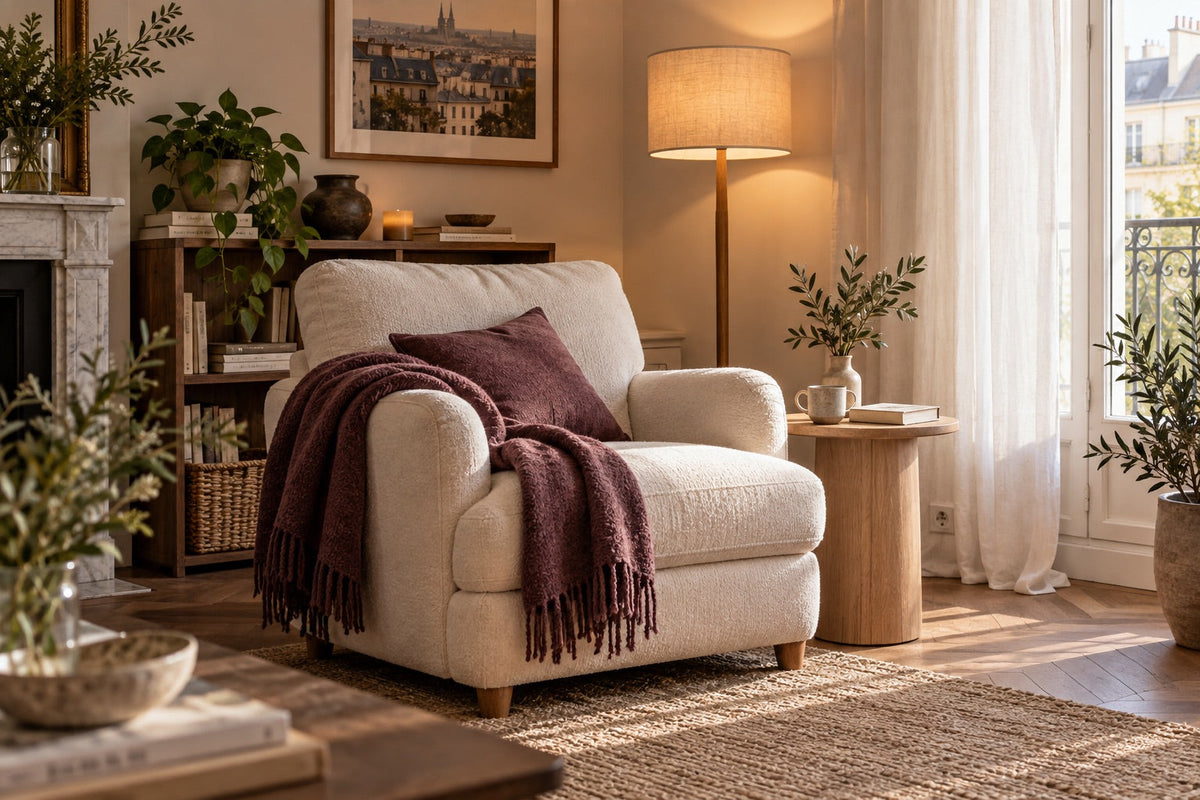
A corner break does not require transforming an entire room. It requires a location that is easy to use, sufficiently clear and compatible with the chosen device. The goal is to limit the small constraints that make you give up: look for a socket, move a table, find a remote control or improvise a storage. By preparing these details, you get a space that is easy to find on a daily basis. Here is how to start from your real home, rather than trying to reproduce a photograph of decoration.
A suitable stand, accessible controls and planned storage are more important than an accumulation of accessories.
Observe how the room is used
First choose a time and place that already exists in your day. An armchair near a window may seem ideal in a photo, but be constantly crossed by other occupants. A more discreet place, where you can sit without moving several objects, will sometimes be more pleasant. Look at the passages, the doors and the proximity of children or animals.
Avoid building your installation around a unique scenario. If you need to reorganize the living room at each session, preparation becomes the main event. A good solution can be very modest: a stable seat, storage nearby and an accessible socket when necessary. The space must also allow you to get up without pulling on a cable or hitting the device installed in front of you.
Check the support before decorating
The intended seat, bed or support must match the authorized uses for the model. Not all cushions attach to all chairs, and not all mats install on any surface. Check the placement instructions and check the dimensions, stability and access to the fasteners. A tight strap does not compensate for an unsuitable backrest shape.
If the product changes your sitting height or distance from the floor, take time to assess the difference before switching it on. Check that you can place your feet comfortably and reach the controls. Do not fill every gap with improvised objects: stacking extra items can make the setup unstable. The right support is one that meets the model’s requirements without complicated adjustments.
Plan a clear route for cables
Locate the actual available socket and length, taking into account the path to the device. A fairly long cable in a straight line can become too short once a piece of furniture or armrest is bypassed. Keep it out of the passageways, casters and moving parts. The power supply must remain accessible to be able to disconnect without moving a library.
Do not hide a damaged cable behind the decoration or pinch an adapter under a piece of furniture. If the installation requires connections that you do not control, choose another location or ask for a qualified opinion. For a battery model, the question moves to the charging area: it must also be compatible with the instructions of the manufacturer, without exposure to water or excessive heat.
Keep the controls visible and accessible
Place the remote control where your hand naturally finds it, before settling down. If it is wired, check that the wire follows the movement without traction. If the panel is built-in, make sure that it will not be hidden once seated. A legible front control can become difficult to distinguish in a very low light.
A soft light can stay clear enough to read the pictograms. A book, glasses or glass can be placed nearby, keeping liquids away from electrical equipment. If you use a phone to drive a compatible model, provide a stable stand and avoid having to hold it in an uncomfortable position during the entire break.
Leave space around the setup
A soothing room doesn’t need a collection of items presented as indispensable. Start with what really bothers you: a table too close, a frequent notification, direct light in the eyes or a pile of belongings on the seat. Removing an obstacle sometimes brings more than buying a new accessory.
Textiles and decorative cushions should not cover the device or change its installation outside the allowed indications. The fact that a plaid appears in a visual does not mean that it must cover a heating area. Separate the decoration from the technical configuration. You can keep a warm atmosphere while leaving free the parts that must remain so and keeping the controls easy to reach.
Plan the end of the break too
Plan where the unit will be placed after use. Storage that is too high, too narrow or requires several manipulations can be impractical. Respect the cooling, drying and storage form indicated in the user manual. A flexible product is not automatically designed to be folded anywhere, even if it enters a drawer more easily.
Keep the accessories specific to the reference together: power, remote control and instructions. A small label on the storage box avoids mixing adapters that look the same. If the space is shared, simply explain where to put each item. This organization does not promise more frequent use; it allows you to find a complete set and quickly check its status during the next installation.
Try a setup you can easily change
Before dedicating a corner of the compartment to this use, test the organization several times under the authorized conditions. Note the small difficulties: pulling the chair, bypassing a cable, lack of light or not being able to reach the stop. Correct these points first rather than looking for a perfect atmosphere. The comfort of a space is also judged by the ease of getting out.
You can then add the decorative elements that you like, without touching the security constraints. A good relaxing corner remains an ordinary place, suitable for the person who uses it. It does not need to look like a care space or promise a particular effect. Its success is due to a coherent organization: install easily, use as intended, then store without improvisation.