

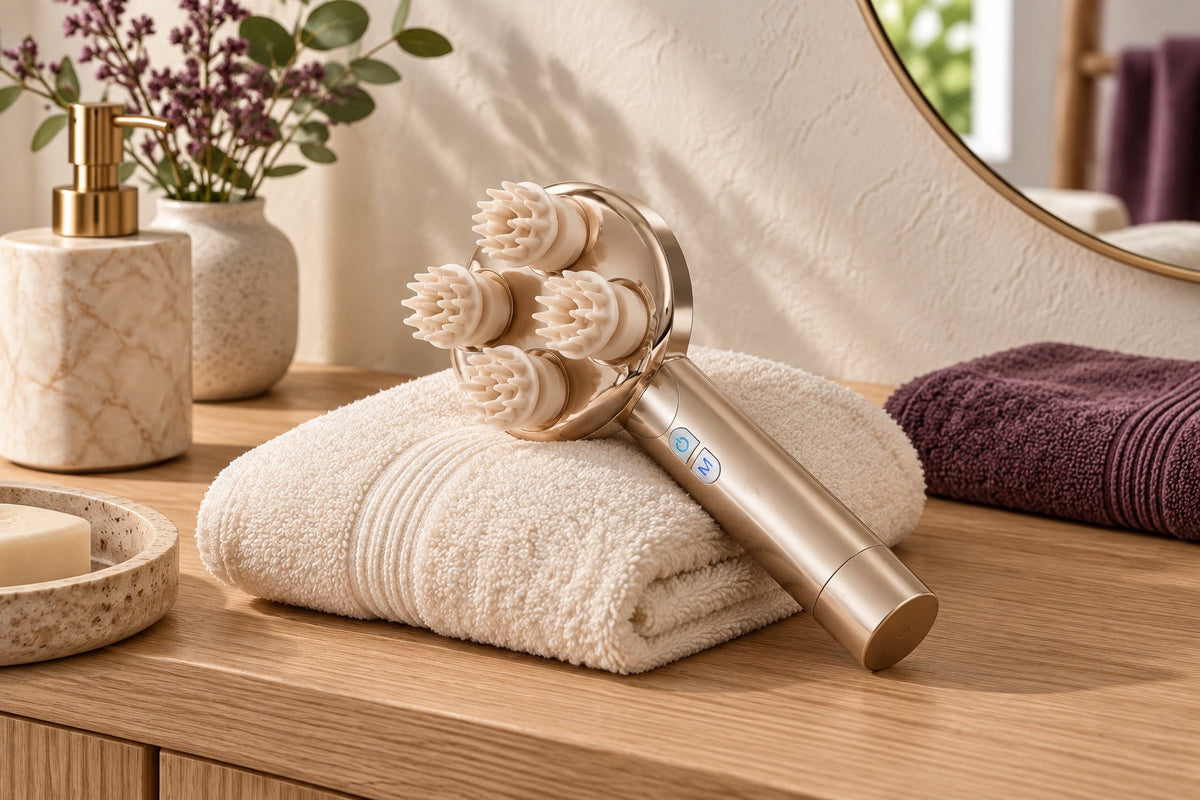
Head massagers can have very different shapes and conditions of use. Some are designed for dry contact, others have a water resistance defined by their manufacturer. The presence of soft heads or a compact housing does not allow to conclude to use in the shower. Before the first use, check the authorized surfaces, the intended movement and the cleaning of each element. The apparent simplicity of the product does not replace its instructions.
Check the conditions of contact with water, avoid forced movements in the hair and maintain each piece according to its actual status.
Identify the intended areas and movements
Consult the reference illustrations to understand where to place the heads and how to move the device. A product intended for the scalp is not automatically adapted to the face or other part of the body. The shape of the tips may influence the gesture, but it does not constitute a permission for use. Use the explicitly indicated areas rather than testing possibilities by analogy.
Identify moving parts and grip points. The housing must be able to be held without covering a necessary control or risk letting go of the device. If you have long hair, accessories or a hairstyle likely to hang, consult the corresponding recommendations. Do not try to pass the mechanism in a knot or under a tie.
Understand the limits of water resistance
An indication of water resistance applies to specific conditions. It does not allow to conclude that the product supports any immersion, any temperature or a rinsing of its electrical accessories. Check separately the housing, the tips, the base and the charger. A washable part does not imply that the whole device can be placed under a tap.
If wet use is allowed, follow the manufacturer’s guidelines. If not, keep dry use. Do not rely solely on a bathroom image or general commercial term. If the user manual does not specify an important condition, ask for confirmation before testing, especially for connections and charging operations.
Establish a secure grip
Before starting, check the condition of the heads, their assembly and the cleanliness of the surfaces. A removable head must be properly put back in place according to the planned procedure. Do not use a part that seems badly started or damaged. Keep the controls visible and detect the stop before bringing the product closer to the hair.
Take the position indicated without unnecessarily straining the arm or wrist. A mirror can help to understand the placement, but it should not divert attention from the gesture. Do not combine the first use with another activity. The goal is to learn how to move and stop the device, not to extend the test to test all the settings at once.
Move without forcing or snagging
Follow the recommended movement and avoid exerting extra pressure to get a stronger feel. Heads should work in the conditions provided by their design. If the hair hangs, stop the mechanism before releasing the device according to the user manual. Do not pull the case abruptly to release a lock while it works.
Hair products, oils or foams should only be associated with the device if the manufacturer allows it. They can change the handling, cleaning or behavior of materials. An advertised use on damp hair does not necessarily mean that a cosmetic product can be added. Always distinguish the condition of the hair, contact with water and the use of an additional substance.
Respect settings and limits
Check the maximum duration, possible breaks and restrictions of the model. A small device may have an automatic stop, but it does not determine the duration that suits everyone. You can interrupt the use earlier. Do not restart successive cycles to compensate for a setting that you consider too discreet.
Look for warnings about situations where use is not recommended. In the presence of irritation, special sensitivity or a medical question, seek competent advice before the test. Feelings of comfort do not constitute proof of treatment or a promise concerning the hair or scalp. This article remains an installation and maintenance guide, not a personalized medical recommendation.
Clean attachments as instructed
Stop the product and disconnect its power supply before maintenance. Remove the tips only if the user manual provides for this operation and indicates how to proceed. Clean them with the products and the authorized method. Do not force on an axis or a connector to reach an area that seems dirty; some parts are not intended to be disassembled by the user.
Allow the affected parts to dry completely before reassembly and before charging, according to the manufacturer’s instructions. Check the cavities and fittings where moisture may remain less visible. Put each element in the right direction, without mixing accessories of another reference. A similar part is not necessarily compatible with the mechanism.
Store with the correct accessories
Choose storage that protects the heads and keeps the charger away from wet areas. Do not place heavy objects on the product and do not compress the tips in a drawer that is too full. Respect the storage conditions of the battery if the model is rechargeable. The presence of a base does not mean that the device must remain connected without interruption.
Before reusing or sharing the product, check the assembly and cleanliness. In case of missing part, unusual load or mechanism that hangs despite a correct installation, contact the support with the reference. Describe the context and the part concerned without continuing the tests. Proper maintenance facilitates a clear use; it does not require improvised disassembly or aggressive products.